
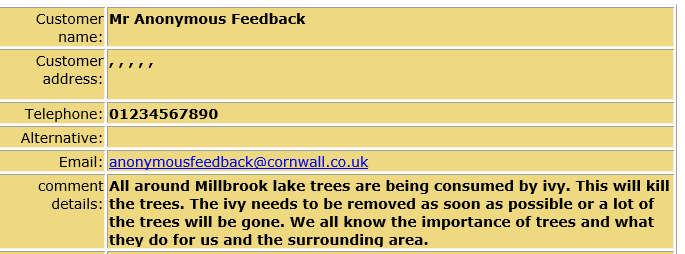
The Council has received communication regarding concerns over Ivy on the trees.
Ivy isn’t parasitic, doesn’t ’smother’ trees and generally co-exists happily with healthy trees. It can conceal areas of disease or weak branches or the Ivy gets high up into the canopy creating a ‘sail’ in a wind exposed tree.
The Council’s grass cutting / groundwork maintenance contractor has provided this link: https://www.rhs.org.uk/weeds/ivy-on-trees-ground-cover-weed
The Council seeks expert advice from an arboriculturist Quantified tree survey reports are produced and the Council aims to act on any points raised acted in a timely manner. Periodic specialist inspection are supported by regular, routine visual checks.
If you do have any concerns and spot any fallen trees / potential hazards please contact the Council by email to theclerk@millbrook-pc.gov.uk or send a private message to the Council’s Facebook page.


If more than fifty percent of trees in an enclosed space woodland are blighted by ivy, the ivy can overtake the woodland, weakening trees by reducing their ability to in effect breathe and by spoiling the structure of the soil. If you need to see the deleterious effect of ivy on woodland go to Harnham , near Salisbury, where, on Harnham Hill there are two areas of woodland. On one side the ivy has been allowed to run riot whereas all the tree bound ivy on the other side of woodland has been killed. In March last year there were gales and the untreated side – over 100 trees were felled by the winds but the other side, where the tree bound ivy had been finished using a hand saw, the tree loss was about 20 trees. This is the proof that tree bound ivy finishes trees off. The proof is in the actuality.